
Drain Field Replacement in Suffolk, VA
Drain field replacement in Suffolk, VA is the job that follows when the trenches behind the tank have clogged or saturated past the point of a part swap. It is a permitted repair in Virginia, it begins with a private soil evaluation rather than a shovel, and on the city's flat, low-lying ground the soil often decides what kind of field can go in. Here is the sequence, the paperwork and fees, the soil questions, and the published price ranges.
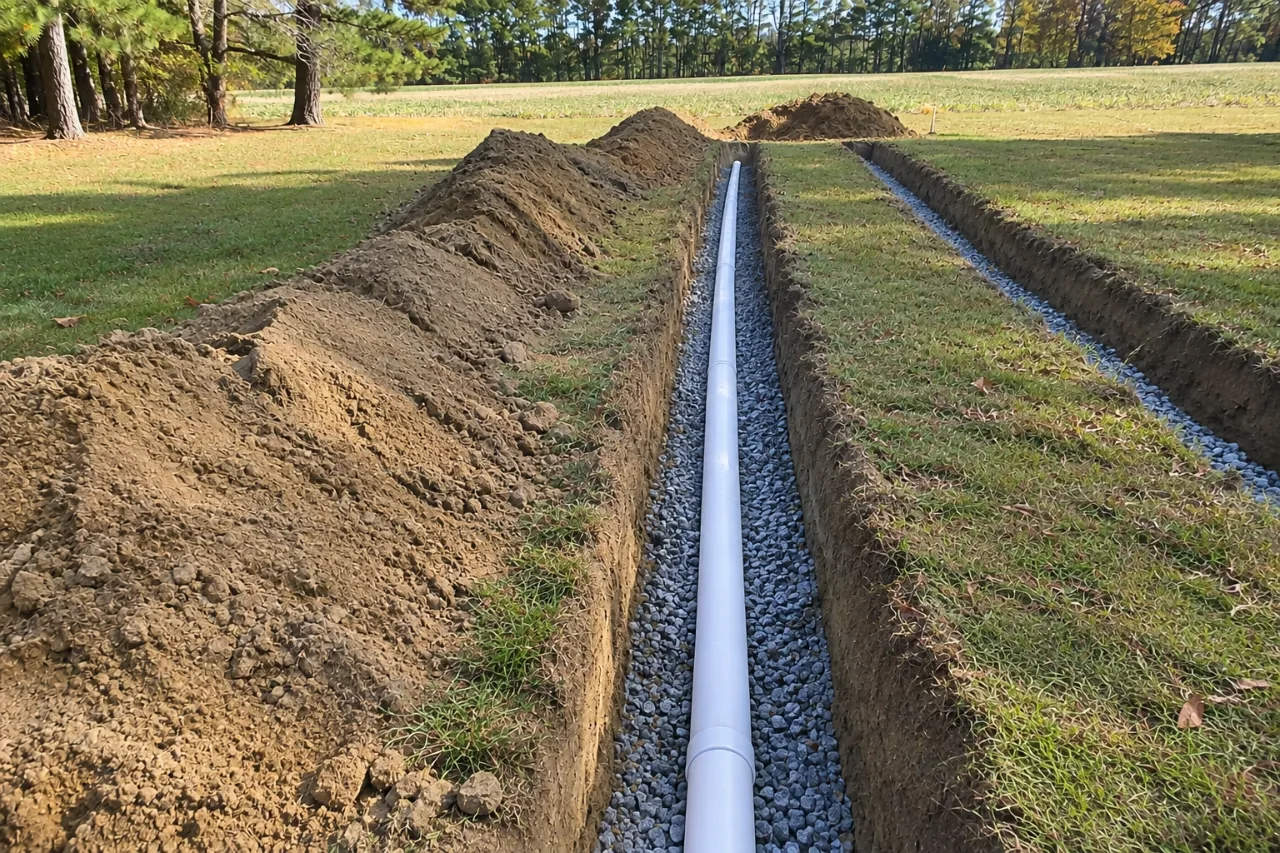
When the field has to be replaced
Virginia Cooperative Extension lists the signs of a failing system as wastewater backing into the house, sluggish drains, discolored or smelly water standing over the field, and sewage reaching the surface. When the cause turns out to be the trenches themselves, rather than a pipe, a baffle or the distribution box, the fix is new absorption area. VDH's 2018 flyer is plain about it: "A permit is required for the replacement of tanks or absorption field components."
If the failure was found by the health department, it issues a Notice of Alleged Violation with steps and a deadline, according to Extension. If you found it yourself, or a buyer's inspector did, the permit process is the same.
First, check whether city sewer reaches you
Before paying for a new field, find out whether a sewer main runs near the property. Suffolk's Department of Public Utilities maintains 393 miles of sanitary sewer collection mains, and its Engineering Division takes questions about where the city's utility systems reach and about extending sewer to a neighborhood at (757) 514-7000, extension 3. The city's pump-out program also skips properties scheduled to be served by sanitary sewer within the next five years. If sewer is close, ask about connection costs alongside the drain field quote.
The replacement, step by step
- Pull the records. The Suffolk Health Department keeps records on permitted systems; Virginia's 2025 inspection law has inspectors take a system's size from local health department records. Knowing the original design, the bedroom count it was sized for, and whether a reserve area was set aside saves time.
- Soil evaluation and design. Since August 11, 2019, onsite sewage applications must include supporting work from a DPOR-licensed private onsite soil evaluator or professional engineer. Extension says the evaluator, sometimes with an engineer, typically evaluates the site and designs the repair. Owners at or below 100% of the federal poverty guidelines, or who meet VDH's hardship guidelines, can petition for VDH to do it.
- Repair permit. The design goes to the Suffolk Health Department, 135 Hall Avenue, Suite A, (757) 514-4700, with the fee: $225 for a system under 1,000 gallons per day with the private evaluator's or engineer's documentation, $425 without it, and $1,400 above 1,000 gallons per day (Western Tidewater fee table, checked October 2026).
- Ask about a waiver. For a failing system serving one to four homes, the owner may request a waiver from certain added treatment or pressure-dosing requirements, under Code of Virginia § 32.1-164.1:1. More on that in septic system replacement.
- Installation. The field is built to the permit. Virginia licenses onsite sewage system installers in conventional and alternative versions; the alternative license covers both kinds of systems.
- Health department follow-up. The Western Tidewater district's septic program includes system inspections. Ask the health department when it needs to see the work before the trenches are covered.
- Restore the yard. Sod over the new field is often its own line item. HomeServe's June 2025 guide puts sod at $1 to $2 per square foot.
Reserve areas and where the new lines can go
Extension describes four places a replacement field can go: a reserve area set aside on the original permit, usable soil between the old trenches, a new area on the property, or neighboring land. Whether your permit has a reserve depends on the soil. VDH requires a 50% reserve where trenches sit in silty or clayey soils, while sand, loamy sand, sandy loam and sandy clay loam need none, per Extension, which adds that some localities require more for new construction. Moving the field to a new spot is itself a reason the job needs a permit, according to the VDH flyer.
Wet ground on the coastal plain
Suffolk is flat, and on flat ground a few feet of height can change how wet the soil stays. The federal description of the Suffolk soil series, whose type location is in the city near Chuckatuck, calls it very deep and well drained, on uplands and stream terraces. The same description lists Lynchburg, Nansemond, Goldsboro and Eunola soils as not as well drained and found on slightly lower ground.
Lynchburg soils are classed somewhat poorly drained, on marine terraces and flats, with a seasonal high water table just 6 to 18 inches down from November to April and a gray sandy clay loam and clay subsoil with masses of oxidized iron. EPA names high water tables among the causes of hydraulic failure, and Extension lists an alternative system, which treats effluent so it can be dispersed in a smaller area, as one of the repair options. Alternative septic systems explains those.
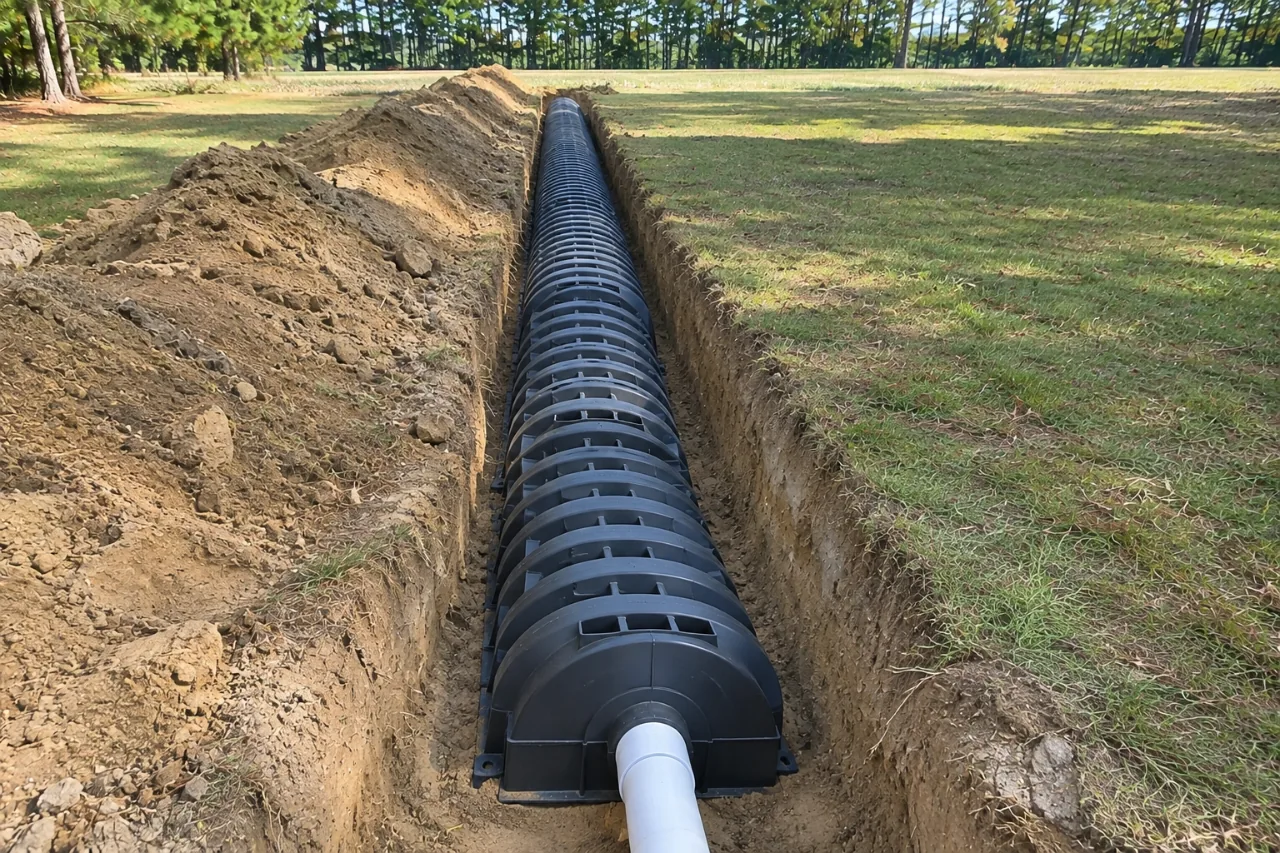
Gravel trenches and chambers
A traditional drain line is perforated pipe bedded in gravel. Some fields use open-bottomed plastic chambers instead, which leave an open space over the soil without the gravel. HomeAdvisor's 2025 guide prices a chambered system at $5,000 to $12,000, with an average of $8,500. Which one goes in is part of the evaluator's design and the permit, so ask why the design calls for one or the other.
What a new drain field costs
Published ranges (national)
- Replace a drain field
- About $7,000 (HomeAdvisor, 2025)
- Install a drain field
- $5,000–$12,000 (HomeAdvisor, 2025; HomeServe, Nov. 2025)
- Leach field replacement
- $3,000–$15,000 (HomeServe, June 2025, citing HomeGuide)
- Mound field
- $10,000–$20,000 (HomeServe, June 2025)
- Perc test
- $600–$2,000 (HomeServe, June 2025)
- Tree removal
- $300–$2,000 (HomeServe, June 2025)
- Suffolk repair permit
- $225 with private evaluator or engineer work; $425 without (Western Tidewater, 2026)
HomeServe says labor is often at least 60% of the total, and that the low end of its range fits a small system on a lot clear of trees. None of these are Suffolk quotes. The cost guide has more, and the contractor's written price is what you'll pay.
Replacement questions
Does a new drain field need a soil evaluator?
Yes, in nearly every case. VDH has required private onsite soil evaluator or professional engineer work with applications since August 11, 2019. The exception is an owner who petitions for VDH services and meets the income test or the hardship guidelines.
Can the new field go where the old one was?
Sometimes. Extension lists the soil between the old trenches as one option, but it depends on what the evaluator finds. Putting any component in a new location requires a permit either way.
Is replacing a field that hasn't failed yet treated differently?
It's a voluntary upgrade under Code of Virginia § 32.1-164.1:3, which still requires a construction permit. The Western Tidewater fee for a voluntary upgrade under 1,000 gallons per day, with private evaluator or engineer documentation, is $225.
How this site helps
Send a request or call, and one independent local septic contractor who works in Suffolk gets in touch to look at the field and talk through the evaluation, permit and price. The referral is free.
Sources
- VDH, July 1, 2018 septic changes flyer; EPA, Resolving Septic System Malfunctions (January 2025 archive)
- Virginia Cooperative Extension, What Happens If My Septic System Fails? (SPES-379), April 29, 2022
- VDH, Septic, Sewage, and Well Applications, updated March 5, 2025
- Western Tidewater Health District, Environmental Health, updated May 12, 2026
- Code of Virginia, §§ 32.1-164.1:1 and 32.1-164.1:3; Chapter 24.2 of Title 59.1 (septic system inspectors)
- City of Suffolk, Public Utilities, Public Utilities FAQ and Septic Tank Pump Out Program
- USDA NRCS, Official Series Descriptions: Suffolk and Lynchburg
- HomeAdvisor, septic system cost, 2025 guide (no month given); HomeServe, leach field replacement, June 16, 2025, and septic tank system cost, Nov. 23, 2025
Facing a new drain field?
Talk it through with one independent local septic contractor. They quote the work themselves, and the referral costs nothing.