
Drain Field Repair in Suffolk, VA
Drain field repair in Suffolk, VA can mean anything from digging up one cracked distribution box to rebuilding trenches that no longer take water. Which one you're facing decides the price, whether the Virginia Department of Health has to issue a permit, and whether a private soil evaluator gets involved. This page explains how a field fails, which fixes Virginia counts as maintenance, which need a repair permit, the repair options, and published costs.
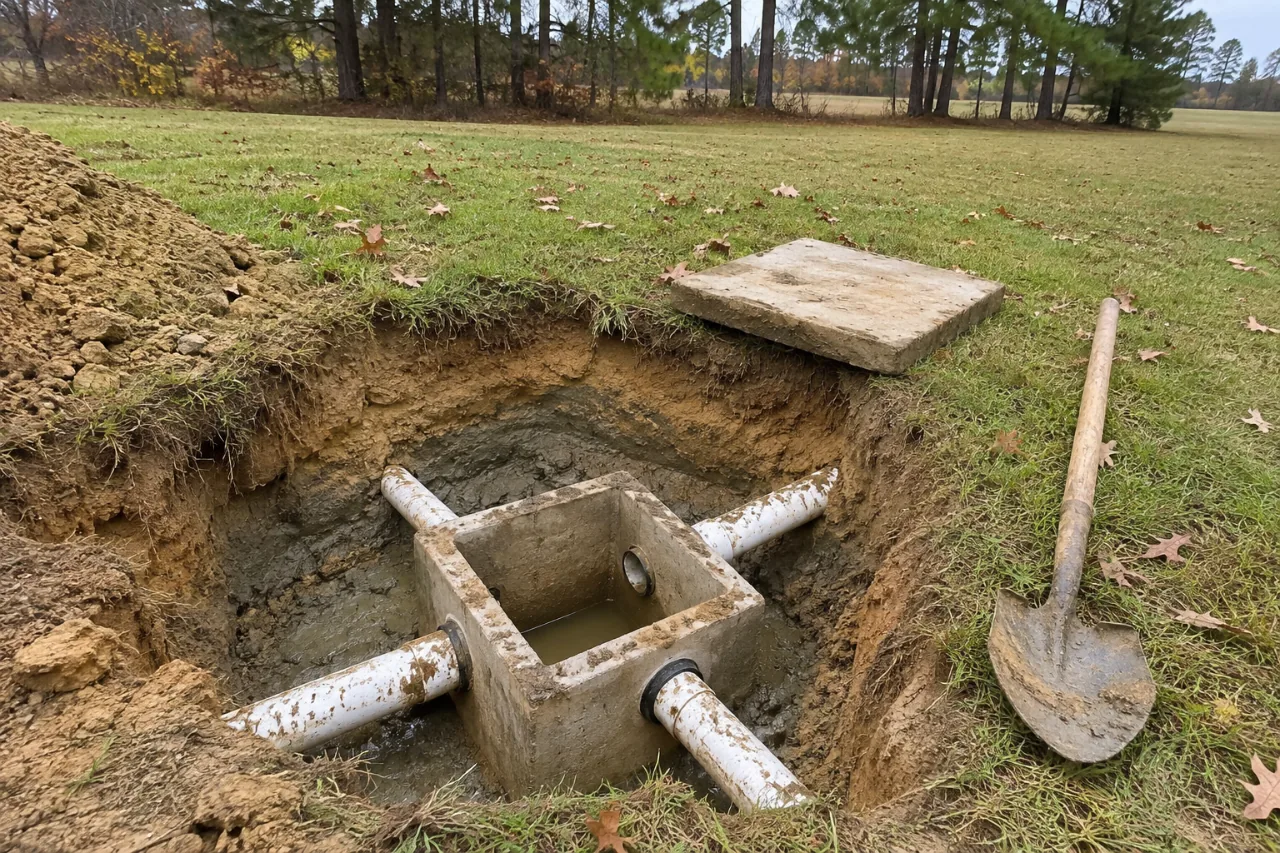
The parts between the house and the soil
Wastewater leaves the house through the sewer line and settles in the septic tank, where solids sink and scum floats. The liquid that leaves the tank, called effluent, travels through a conveyance line to a distribution box. From there, header lines split the flow among the drain lines, which let it seep into the ground. The soil under those trenches is the last stage of treatment, which is why the drain field is the part of a septic system that is hardest and most expensive to replace.
Those names matter because Virginia's rules treat each part differently. A VDH flyer on the changes that took effect July 1, 2018 lists the sewer line, conveyance line, distribution box and header lines as parts that can be replaced without a permit, and the tank and "absorption field components" as parts that can't.
Why drain fields stop draining
Virginia Cooperative Extension's publication on septic failure (SPES-379, April 2022) names these causes:
- Solids carryover. A tank that isn't pumped often enough fills with suspended solids, and those solids move on into the field and clog it.
- Worn baffles. If the outlet baffle fails, solids go straight to the field. Extension says baffle decay is more common in concrete tanks.
- Hydraulic overload. A system that's too small for the household sends more water to the field than the soil can absorb.
- Building or planting on the field, which compacts or disturbs the trenches.
- Tree and shrub roots, which go after the water and nutrients in the lines.
- Periods of extremely heavy rain, which Extension lists among the other factors that can cause failures.
EPA adds that poor soils and high water tables can cause hydraulic failures. That's a real factor on Suffolk's flat coastal plain. Lynchburg soils, which the federal description of the Suffolk soil series lists as a less well drained neighbor on slightly lower ground, carry a seasonal high water table 6 to 18 inches below the surface from November through April. A field built close to that layer has little dry soil to work with in winter.
Is it the field, or something smaller?
Not every symptom means the trenches are finished. Extension points out that slow tubs and sinks can be a simple clogged pipe, and that greener grass over the lines can come from drought or low soil fertility rather than effluent rising. Sewage on the surface, water standing over the field, or wastewater backing into the house are stronger signs.
Questions to ask whoever looks at it: When was the tank last pumped, and what did the solids look like? Is the outlet baffle intact? Is the distribution box level, cracked, or full of solids? Are the trenches holding water, and at what depth? The answers separate a maintenance fix from a permitted repair.
Fixes that count as maintenance
These need no VDH permit, according to the 2018 VDH flyer, as long as the new part goes in the same place as the old one:
- Replacing the sewer line from the house to the tank.
- Replacing the conveyance line from the tank toward the field.
- Replacing the distribution box. Extension's guide also lists this as maintenance.
- Replacing the header lines that feed the drain lines.
The Code of Virginia (§ 32.1-163) adds that maintenance includes pumping the tanks and periodically cleaning the building sewer. The same flyer says DPOR-licensed operation and maintenance providers and installers may do maintenance, with conventional installers limited to conventional systems and alternative installers allowed on both kinds.
Repairs that need a permit first
The Code's definition of maintenance stops short of "replacement of tanks, drainfield piping, subsurface drainfields." Replacing absorption field components, or moving any component to a new location, takes a repair permit from the health department. Extension's guide says the permit "must be issued prior to the repair."
- Site evaluation and design. Since August 11, 2019, VDH requires that onsite sewage applications come with supporting work from a DPOR-licensed private onsite soil evaluator or professional engineer. Owners whose household income is at or below 100% of the federal poverty guidelines, or who meet VDH's hardship guidelines, can petition for VDH to do that work instead.
- Application and fee. The Western Tidewater Health District charges $225 for a repair permit under 1,000 gallons per day when the application includes the private evaluator's or engineer's documentation, and $425 without it. The district's fee page says fees are subject to change.
- Permit, then the work. The repair is built to the permit by the contractor.
In Suffolk, applications go to the Suffolk Health Department at 135 Hall Avenue, Suite A, (757) 514-4700, open weekdays 8:00 a.m. to 4:30 p.m. The permit guide covers every case.
The repair options
Extension's guide describes repairs that range from single components to replacing the entire system. When the trenches themselves have failed, the evaluator's design may call for new lines in a reserve area set aside on the original permit, in usable soil between the old trenches, in a new part of the property, or on neighboring land. On a lot without enough suitable soil, an alternative system that treats effluent before it reaches the ground can fit into a smaller area. Extension describes pumping and hauling by licensed professionals only as a stopgap until the repair is done.
Whether a reserve area exists depends on the soil and the permit. Extension notes that VDH requires a 50% reserve where trenches sit in silty or clayey soils, but not in sand, loamy sand, sandy loam or sandy clay loam. Drain field replacement walks through a rebuild, and alternative septic systems covers the treatment options.
What drain field repairs cost
Published figures are national. HomeServe's leach field guide (June 2025, citing HomeGuide) puts typical repairs at $1,000 to $5,000, hydro jetting of clogged lines at about $250 to $800, and replacing leach line at $20 to $45 per linear foot. Bob Vila's December 2023 guide gives $2,000 to $15,000 for drain field repair. Full replacement is a bigger number, covered in the cost guide. In Suffolk, add the $225 or $425 permit fee for any permitted repair, plus the evaluator's or engineer's charge for the design. The contractor's written quote is the number that counts.
Before you hire
Licensing, insurance, permits, pricing and warranties are each contractor's own responsibility. The Board for Waterworks and Wastewater Works Operators and Onsite Sewage System Professionals licenses conventional and alternative onsite sewage system installers, operators and soil evaluators. A contracting firm also carries a Board for Contractors specialty, such as conventional sewage disposal system contracting (CDS) or alternative sewage disposal system contracting (ADS). Both can be looked up on DPOR's License Lookup, and who repairs septic systems lists questions to ask.
Drain field repair questions
Is replacing a distribution box a permitted job?
No. VDH's 2018 flyer lists the distribution box among the parts that can be replaced without a permit when the new one goes in the same location. Moving it somewhere else does need a permit.
Does a soggy spot over the field always mean it has failed?
Not always, but it is a warning sign. Extension says standing water over the field can indicate failure, especially if it is discolored and smells, and that greener grass can also come from drought or low fertility. Sewage on the surface is a much clearer sign that the system has failed and needs a look.
How long does a drain field last?
HomeServe's 2025 guide, citing EPA, gives 15 to 40 years, and notes that poor care can shorten that a lot. Regular pumping keeps solids out of the trenches, which is the main thing an owner controls.
Will the health department get involved?
For any permitted repair, yes. The Western Tidewater Health District's septic program also investigates sewage complaints, and Extension notes that when a failure is documented, the health department issues a Notice of Alleged Violation that sets out the steps to fix it and a time frame.
How this site helps
Call or send a request and it goes to one independent local septic contractor who works in Suffolk. They look at the system, tell you what they found and price the repair themselves. You pay nothing for the introduction.
Sources
- VDH, July 1, 2018 septic changes flyer
- Code of Virginia, Title 32.1, Chapter 6, Article 1 (§ 32.1-163 definitions)
- Virginia Cooperative Extension, What Happens If My Septic System Fails? (SPES-379), April 29, 2022
- VDH, Septic, Sewage, and Well Applications, updated March 5, 2025
- Western Tidewater Health District, Environmental Health (fees), updated May 12, 2026, and Locations
- EPA, Resolving Septic System Malfunctions (January 2025 archive)
- USDA NRCS, Official Series Descriptions: Suffolk and Lynchburg
- HomeServe, leach field replacement cost, June 16, 2025; Bob Vila, cost to replace a septic tank and drain field, Dec. 12, 2023
- Board for Contractors, 18VAC50-22-30; DPOR, Board for Waterworks and Wastewater Works Operators and Onsite Sewage System Professionals
Want the field looked at?
One independent local septic contractor, their own quote, and no referral fee for you.