
Septic Inspections for Home Sales in Suffolk, VA
A septic inspection for a home sale in Suffolk, VA now follows state law changes that took effect July 1, 2025. They decide who may inspect, what the written contract and report must say, and why a complete inspection includes pumping the tank. If you're selling, buying or refinancing a house on septic in the city, or you've just received an inspection report full of findings, this page explains the rules, what the report can and can't tell you, and what happens when a repair is needed.
Is an inspection required to sell?
No. Virginia REALTORS' FAQ on the law says plainly that it "does not require a septic inspection for the sale of a residential property." What the law does is set standards for an inspection when one is requested as a condition of a sale, refinancing or transfer of title, for example by a lender or a buyer. The law is Chapter 24.2 of Title 59.1 of the Code of Virginia, "Septic System Inspectors," with the main rules in § 59.1-310.9.
Who may inspect
Only a person holding a valid onsite sewage system operator, installer, or onsite soil evaluator license issued under Chapter 23 of Title 54.1, which is the Board for Waterworks and Wastewater Works Operators and Onsite Sewage System Professionals at DPOR. Doing a covered inspection without one is a Class 3 misdemeanor under § 59.1-310.10. You can check anyone's license on DPOR's License Lookup; who repairs septic systems explains the license types.
Before the inspection: the contract
Section 59.1-310.9(B) requires a written contract, signed before any work, that:
- Describes the scope of the inspection and what it will cost.
- Gets permission to do the inspection.
- States that a complete inspection requires pumping the septic tank.
The person ordering the inspection may decline pumping, but that decision has to be documented. It's worth asking what pumping will show for your tank: Virginia Cooperative Extension notes that decayed baffles, which it says are more common in concrete tanks, let solids pass into the drain field.
What gets inspected
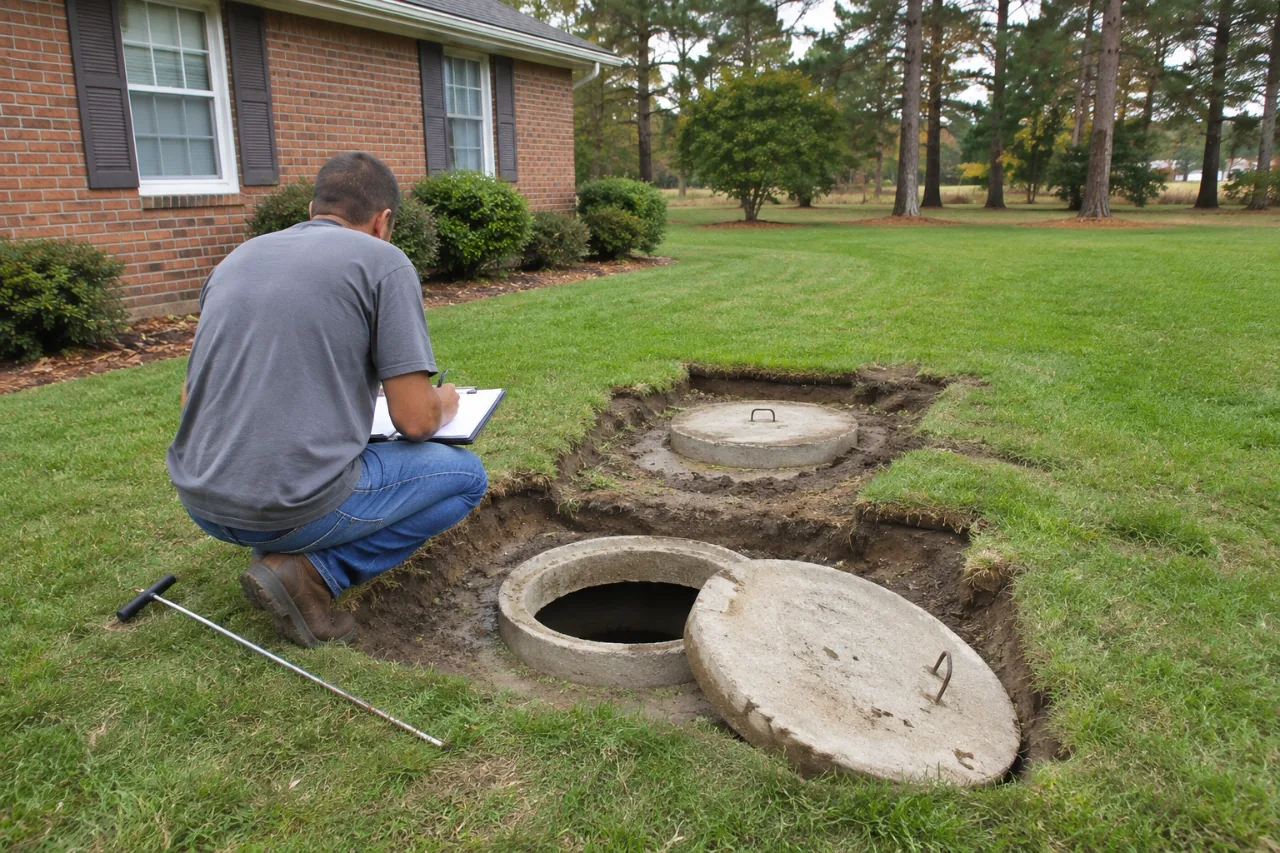
Virginia REALTORS' summary says inspections "must include inspection of all readily accessible and openable components," and that walkover and rod-probing inspections are no longer an option. "Readily accessible" has a limit: under § 59.1-310.7, it doesn't include removing more than 30 inches of surface material to reach access lids or inspection ports. The law defines a septic system broadly, from tanks and distribution devices to pumps and the dispersal field.
An inspection isn't a soil evaluation. Observations of the drain field are limited to visible saturation, surfacing or ponding, so the report can tell you water is rising in the yard, but not whether the soil could support a new field.
The report
- Timing: delivered within 10 business days of the inspection's start, unless the parties agree otherwise in writing.
- Contents: the components inspected, an explanation of anything left out, any adverse conditions found, and whether the system is operating as intended.
- System size: the size or capacity in gallons per day or bedrooms, based on local health department records.
- Operator note: whether a licensed operator is required, which is the case for an alternative system, with a referral to the health department for operation and maintenance reports.
- No grade: inspectors may not give pass or fail determinations or graded assessments, and may not perform hydraulic load tests.
So a report won't say "failed." It will list deficiencies, and Virginia REALTORS sums it up the same way: the inspection "will only note deficiencies in the septic system, not whether it passes or fails." Deciding what a deficiency means for the sale is up to the buyer, the seller and their agents, often with a contractor's quote in hand.
Sellers: what you owe a buyer
If your system was repaired under a failing-system waiver from certain treatment or pressure-dosing requirements, Code of Virginia § 32.1-164.1:1 says the waiver is void on sale, except for the transfers listed in subsection C, and you must deliver a written disclosure on a Real Estate Board form to the buyer before the purchase contract is accepted. Other paperwork that helps a sale: pump-out receipts (the city asks owners to keep them five years), the health department permit for the system, and, for an alternative system, the operator's log and maintenance manual that 12VAC5-613-140 requires owners to keep at the property.
When the report finds a problem
The fix decides the paperwork. A cracked distribution box, a failed header line, or a broken sewer line can be replaced in the same location as maintenance with no VDH permit, according to VDH's 2018 flyer. A failing tank or drain field needs a repair permit from the Suffolk Health Department, (757) 514-4700, with a private soil evaluator's or engineer's design and a $225 fee for a home-sized system with that documentation. A permitted repair has to wait for the permit, so it helps to get the contractor and evaluator moving early when a closing date is set. Drain field repair and septic system replacement cover the work.
Inspection questions
Is a walkover inspection still allowed for a sale?
Not for an inspection covered by the law. Virginia REALTORS says walkover and rod-probing inspections are no longer an option, because the law spells out what an inspection has to include.
Does the inspector say whether the system passes?
No. Section 59.1-310.9 bars pass or fail determinations and graded assessments. The report notes deficiencies and whether the system is operating as intended.
Does a sale inspection count toward the city's five-year pump-out?
The city's program accepts a pump-out or an inspection. Send the documentation with the city's certification form, and call Planning and Community Development at (757) 514-4060 to confirm a sale inspection report meets your notice. Septic pumping has the details.
How much does a septic inspection cost?
The law requires the contract to state the cost before work starts, so ask for it in writing. The City of Suffolk's own pump-out page estimates a pump-out or inspection for its program at $250 to $350, depending on tank size; an inspection for a sale may be priced differently.
How this site helps
If an inspection turned up a problem, or you need one before listing, a request here goes to one independent local septic contractor in Suffolk. They contact you and quote the work themselves, and the referral costs nothing. Contractors are responsible for holding whatever license the job requires.
Sources
- Code of Virginia, Title 59.1, Chapter 24.2, Septic System Inspectors (§§ 59.1-310.7 to 59.1-310.10)
- Virginia REALTORS, Septic Inspection Legislation FAQ
- Code of Virginia, § 32.1-164.1:1; Virginia Administrative Code, 12VAC5-613 Part III; VDH, AOSS O&M FAQs
- VDH, July 1, 2018 septic changes flyer; Western Tidewater Health District, Environmental Health
- City of Suffolk, Septic Tank Pump Out Program and FAQ
- Virginia Cooperative Extension, SPES-379, April 29, 2022
Inspection turned up a problem?
Get one independent local septic contractor's quote on the repair. The referral is free.